AI Video Pricing Since 2024: Same Plan, Less Video
Runway, Kling, Luma, HeyGen, ElevenLabs: 15 AI video and voice tools tracked since 2024 through their archived pricing pages. Free data and charts to reuse.
Contents
Since 2024, the price of entry-level AI video plans has barely moved, but what they produce with the newest model has often shrunk. Runway Standard still costs $15 a month; it bought 125 seconds of Gen-2 video in May 2024 and buys 52 seconds of Gen-4.5 today, 58% less (May 2024 capture, current page, checked Oct. 5, 2026). Four of the five video generators with a usable history follow the same pattern.
This study tracks 15 tools for AI video generation, script-to-video editing, avatars and voice through their official pricing pages, as archived by the Wayback Machine since 2024, then through their live pages on Oct. 5, 2026 (Oct. 16, 2026, for Kling 4.0, open to everyone since Oct. 15). Every row of the dataset gives its source URL, key figures are linked in the text, and the full dataset is free to download and reuse.
Key Findings
- Sticker prices hold; credits move. Runway ($15), Kling ($8.80), Pika ($10), HeyGen ($29), Murf ($29) and D-ID ($5.90) charge the same monthly price as in their first capture; Synthesia even cut its price, from $29 to $19 for U.S. visitors.
- Each new flagship model burns more credits per second. On the same plan: 58% fewer seconds at Runway, 60% fewer at Kling with Kling 4.0, sound included (33% fewer like-for-like, with silent Kling 3.0, image-to-video), 28% fewer at Hailuo, and 75% fewer on Luma’s Lite plan before it was discontinued. Pika is the exception (+7%).
- When a plan disappears, the entry price jumps. The cheapest paid plan went from $9.99 to $30 at Luma, from $27 to $89 at Colossyan, and from $15 to $24 at Descript.
- Straight price increases happen too. InVideo Plus went from $25 to $35 a month between February and July 2025 (+40%) for the same 50 minutes of AI generation; ElevenLabs Starter went from $5 to $6 a month in April 2026 (+20%) for the same credits.
- HeyGen’s unlimited era is over. The Creator plan offered unlimited videos from late summer 2024 into spring 2026; it now includes 600 credits, or 12.5 minutes with Avatar V.
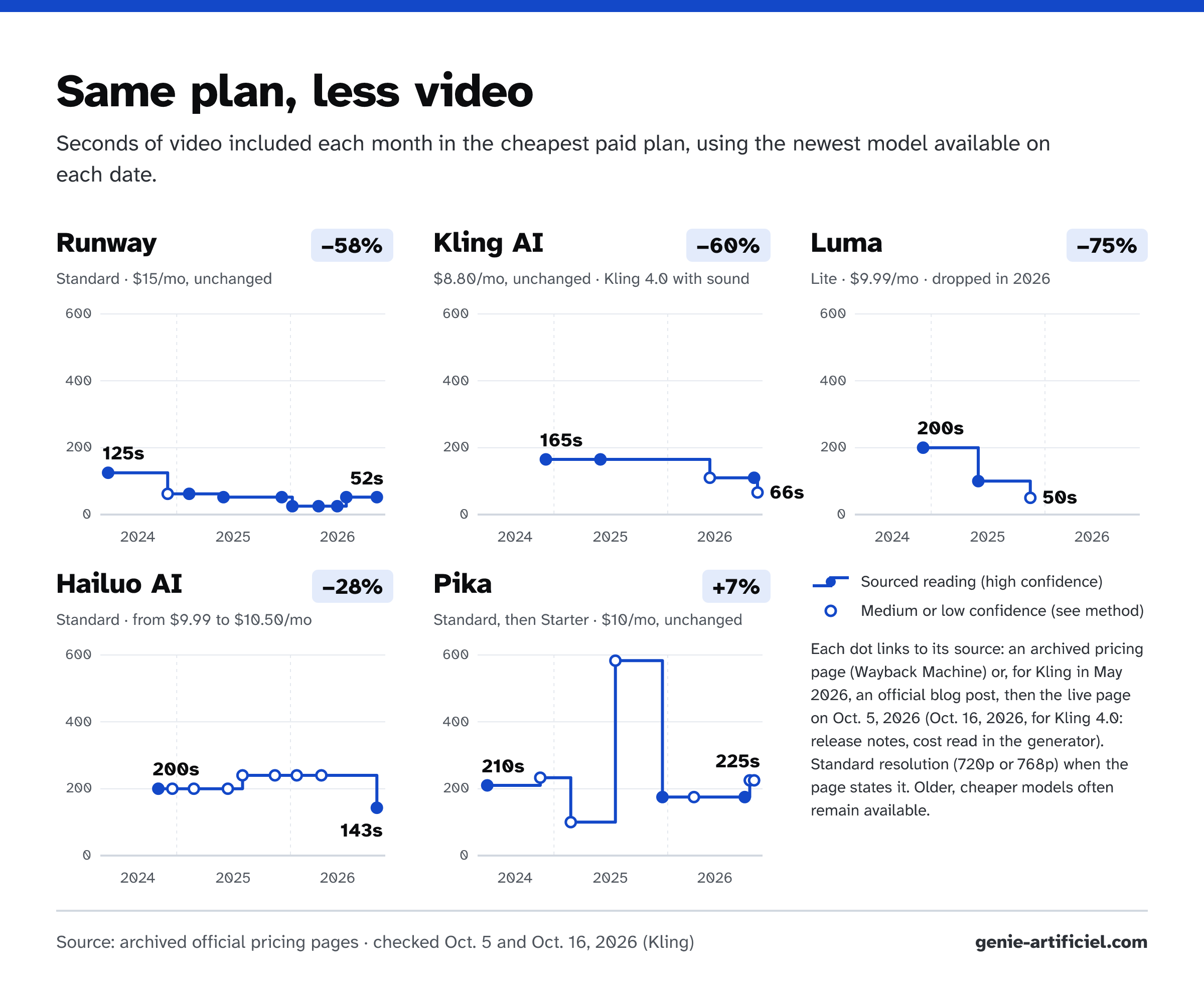
Same plan, less video
Seconds of video included each month in the cheapest paid plan, using the newest model available on each date.
Standard · $15/mo, unchanged
$8.80/mo, unchanged · Kling 4.0 with sound
Lite · $9.99/mo · dropped in 2026
Standard · from $9.99 to $10.50/mo
Standard, then Starter · $10/mo, unchanged
Sourced reading (high confidence)
Medium or low confidence (see method)
Each dot links to its source: an archived pricing page (Wayback Machine) or, for Kling in May 2026, an official blog post, then the live page on Oct. 5, 2026 (Oct. 16, 2026, for Kling 4.0: release notes, cost read in the generator). Standard resolution (720p or 768p) when the page states it. Older, cheaper models often remain available.
Hover over or tap a dot to see the date, model and source.
AI Video Generators: How Many Seconds for the Same Price?
The table compares the first usable capture with the current page. Cost per second divides the monthly price (billed monthly) by the included seconds: it is a calculation, not a published rate.
| Tool and plan | First capture | Today (Oct. 5, 2026) | Cost per second |
|---|---|---|---|
| Runway Standard, $15/mo | May 2024: 625 credits = 125s (Gen-2) | 625 credits = 52s (Gen-4.5), 104s with Gen-4 Turbo | $0.12 → $0.29 |
| Kling AI Standard, $8.80/mo | Dec. 2024: 660 credits = 165s (Kling 1.5, 720p, image-to-video) | 660 credits = 66s (Kling 4.0, 720p, sound included; Oct. 16, 2026) | $0.053 → $0.133 |
| Luma Lite, $9.99/mo | Dec. 2024: 3,200 credits = 200s | Lite gave 50s with Ray3 in Nov. 2025, then was dropped in early 2026; the entry plan is now Plus at $30, 500s with Ray3.2 | $0.050 → $0.060 (Plus) |
| Hailuo Standard, $9.99 to $10.50/mo | Nov. 2024: 1,000 credits ≈ 200s | 1,000 credits ≈ 143s (MiniMax H3, 768p) | $0.050 → $0.073 |
| Pika Standard, then Starter, $10/mo | June 2024: 700 credits = 210s (Pika 1.0) | 900 credits ≈ 225s (Pika 2.5, 720p) | $0.048 → $0.044 |
Runway hit a low point: from January to May 2026, Gen-4.5 cost 25 credits per second, so Standard bought just 25 seconds (Jan. 7, 2026 capture), before a cut to 12 credits per second in June 2026 (June 29, 2026 capture).
Luma shows a different mechanism: Lite lost 75% of its seconds in one year as models changed (Ray 1.6, Ray2, Ray3), then it disappeared. Plus, its replacement, costs three times as much but includes more; per second, it lands close to the late-2024 level.
Pika is the outlier: a peak of 583 seconds in July 2025 with Pika 2.2 at 720p (capture), then back to 175 to 225 seconds with Pika 2.5.
Kling still bought 110 seconds with Kling 3.0 (720p, no audio) on Oct. 5, 2026, or $0.080 per second: 6 credits per second according to the official Kling 3.0 guide, versus 4 with Kling 1.5 in December 2024, whose 720p Standard mode was only available for image-to-video (so the 33% drop applies to image-to-video). With native audio, Kling 3.0 costs 9 credits per second at 720p and 12 at 1080p, according to the same guide: 73 seconds a month, about $0.12 per second ($0.16 at 1080p). Kling 4.0, open to everyone since Oct. 15, 2026, costs 10 credits per second at 720p and has no silent mode, so the same Standard plan now buys 66 seconds. Kling doesn’t publish this rate on its pricing page or in its official guide; it’s read from the generator, which is why this data point is rated medium confidence. Kling 3.0 is still available. Kling 4.0 Flash, announced as more cost-efficient (720p, 3 to 20 seconds), wasn’t offered as a separate model in a free account’s generator on Oct. 16, and its rate isn’t published, so it isn’t tracked here.
Hailuo labels its prices as promotional throughout the period (list price struck through at $14.99). Through April 2026, the price used is the one in the page’s FAQ, the only part readable in archived captures (the plan cards do not render there); on Oct. 5, 2026, it is the one on the cards. That FAQ is out of date: on Oct. 20, 2026, it still shows $7.99 while the cards show $10.50.
InVideo AI, which builds videos from a script, raised the price of its Plus plan without changing the quota: $25 a month for 50 minutes of AI generation in 2024 (June 2024 capture), then $35 by July 2025, when a 10-credit generative video add-on became mandatory (July 10, 2025 capture). In April 2026, InVideo switched to credits and stopped publishing a minute equivalent (April 15, 2026 capture).
Vidu and PixVerse are left out of the chart for lack of a usable 2024 data point: Vidu had no archived pricing page, and PixVerse’s subscription page did not show its plans in captures. Vidu’s archived prices, taken from the API behind its pricing page (which loads with JavaScript), start in May 2025; PixVerse’s, in late September 2026. Today, Vidu Standard costs $10 a month for 800 credits (pricing page) and PixVerse Standard $10 a month for 1,200 credits, about 150 seconds at 720p with PixVerse V6 (checked Oct. 5, 2026).
AI Avatars: More Minutes or Fewer?
| Tool and plan | 2024 | Today (Oct. 5, 2026) |
|---|---|---|
| HeyGen Creator, $29/mo | June 2024: 15 min/month | 600 credits = 12.5 min with Avatar V, about 19 min with Avatar IV with a video look (HeyGen help) |
| Synthesia Starter, from $29 to $19/mo | June 2024: $29/mo, 10 min/month | $19/mo, 1,250 credits + 10 free minutes a month (U.S. visitors), about 22 min by Synthesia’s estimate |
| Colossyan | June 2024: Starter at $27, 10 min/month | Starter free since summer 2026 (20 min/month); cheapest paid plan: Professional at $89, 30 min NEO + 10 min NEO2 |
| D-ID Lite, $5.90/mo | June 2024: 10 min/month | 10 min/month, unchanged |
HeyGen changed the deal twice on the same $29 plan: 15 minutes a month, then unlimited videos from late summer 2024 (the switch happened between July 16 and Sept. 4, 2024, Sept. 4 capture), then credits in May 2026 (May 26, 2026 capture). In late summer 2026, Avatar V went to 48 credits per minute (archived HeyGen help).
Synthesia moved the other way: a steady 10 minutes for two years, then a price cut in late April 2026, when Starter went from $29 to $19 a month for U.S. visitors ($14 billed yearly, April 25, 2026 capture), and more minutes with its September–October 2026 overhaul. The price shown depends on the visitor’s country: from France, Starter costs €19 a month, €12 billed yearly (pricing page, checked Oct. 20, 2026); other countries get a standard rate card, $29 for those billed in dollars. The 22 minutes are Synthesia’s own estimate, not a guaranteed quota.
AI Voice: Straight Price Increases
| Tool and plan | 2024 | Today (Oct. 5, 2026) | Change |
|---|---|---|---|
| ElevenLabs Starter | Dec. 2024: $5/mo, 30,000 credits (≈ 30 min) | $6/mo, 30,000 credits | +20% per minute, raised between April 12 and April 15, 2026 |
| Descript, entry plan | May 2024: $15/mo | $24/mo (Hobbyist) | +60% billed monthly; AI voice minutes no longer stated since late September 2025 |
| Murf Creator | May 2024: $29/mo, 2 hours of voice | $29/mo, 2 hours | Unchanged; annual billing dropped from $23 to $19 a month in summer 2024 |
Descript raised its entry price in two steps: $19 in late July 2024 with the switch to the Hobbyist plan (July 29, 2024 capture), then $24 between March 10 and April 5, 2025 (April 5, 2025 capture). Since late September 2025, AI voice draws on shared credits, and Descript does not publish how many minutes they buy.
Why Does the Same Plan Buy Less Video?
The subscription price is the number everyone compares, so vendors rarely touch it. The adjustments happen through three less visible levers:
- The credit cost of each new model. At Runway, one second cost 5 credits with Gen-2, 10 with Gen-3 Alpha, about 12 with Gen-4 and up to 25 with Gen-4.5 before its price cut. The included credits stayed at 625. At Kling, one second at 720p cost 4 credits with Kling 1.5 (image-to-video), 6 with Kling 3.0 without audio and 10 with Kling 4.0, for the same 660 credits.
- Dropping the cheapest plan. Luma Lite disappeared and Colossyan Starter became free: the next paid plan costs far more.
- Moving to credits. HeyGen, Synthesia, Descript and InVideo replaced stated minutes with credits shared across features, so the real quota depends on the model and options you pick.
Older models often stay available, for far fewer credits: Runway’s Standard plan card lists 104 seconds of Gen-4 Turbo, versus 52 of Gen-4.5. On Gen-4 Turbo, Runway contradicts itself: since June 2026, that card shows 104 seconds instead of 125, or 6 credits per second, but the Max card on the same page still works out to 5 credits per second. What got more expensive is access to the newest model.
Method and Limits
- Plan: the cheapest paid plan for an individual, at the month-to-month price (annual pricing is in the dataset).
- Model: the newest model the vendor promoted on each date, at standard resolution (720p or 768p) when the page states it, without paid options (native audio, 1080p). The percentages apply to that standard resolution; at 1080p, the change varies by tool: about −53% at Kling (94s in Professional mode in December 2024, 44s with Kling 4.0, sound included) and about −48% at Pika between July 2025 and October 2026 (194s, then about 100s). Runway publishes a single rate per model. At Kling, the 720p Standard mode of Kling 1.5 and 2.1 was only available for image-to-video, so the like-for-like comparison with Kling 3.0 applies to that mode. When a clip’s price is not proportional to its length (Luma Ray3.2: 100 credits for 5 seconds, 300 for 10), the calculation uses the shortest length.
- Dates: the Wayback Machine captures closest to June and December 2024, June and December 2025, and April 2026 (within six weeks), plus the captures around each change, then the live page on Oct. 5, 2026 (Oct. 16, 2026, for Kling 4.0).
- Currency: U.S. dollars as displayed, before tax. One data point (InVideo AI, Oct. 5, 2026) was displayed in euros because the page was viewed from France; it is kept in euros, without conversion, and the page does not say whether VAT is included.
- Confidence: each data point is rated high, medium or low. Medium examples: Luma’s August 2024 clip length, inferred from its product page, or the Gen-3 Alpha rate, read from a February 2025 capture, and Kling 4.0’s cost, shown by the generator but not published. Exception: Kling 4.0 has no silent mode, so sound is counted. Medium- and low-confidence points appear as hollow dots in the chart.
- Gaps: no usable archived pricing page for Vidu in 2024 (prices read from the archived API from May 2025), and no archived PixVerse plan price before late September 2026; no Kling 2.5 or 2.6 credit rates in an archived official source.
Costs per second and percentages are calculated from the vendors’ figures (published, or shown in the generator for Kling 4.0). They do not measure video quality or how many attempts a usable shot takes.
Download and Reuse the Data
- The chart as a high-resolution PNG
- Every observation as a CSV file: 128 data points (122 with a price in U.S. dollars, 1 in euros, 5 that only record credit rates, without a plan price) with plan, monthly and annual prices, credits, model, credit conversion, confidence level and the URL of each source, a Wayback Machine capture or the live official page
- The data dictionary as a CSV file: what each column means, in English and French
Data Dictionary
| Column | What it contains |
|---|---|
tool, category | Tool name; category: video (AI video generator), avatar (avatar video), voice (AI voice), script (script-to-video editor) |
date | Date of the source: Wayback Machine capture date, or check date for a live page |
plan | Plan name as displayed |
monthly_price_billed_monthly, monthly_price_billed_annually | Price per month on monthly and on annual billing, in currency, as displayed (empty when not displayed or not recorded, e.g. when the capture only shows the other billing view) |
currency | USD, or EUR for the InVideo AI row of Oct. 5, 2026 (page viewed from France) |
included, included_unit | Quota included in the plan and its unit (free text in French, e.g. “crédits/mois” = credits per month) |
newest_model, resolution | Newest model promoted on that date (free text in French) and the resolution used for the conversion (“non précisée” = not specified, “sans objet” = not applicable, “sans son” = no audio, “son compris” = audio included) |
video_or_voice_per_month, per_month_unit | What the plan buys per month with that model: “s de vidéo/mois” = seconds of video, “min de vidéo/mois” = minutes of video, “min de voix/mois” and “min de voix IA/mois” = minutes of (AI) voice, “min de génération IA/mois” = minutes of AI generation; empty when the plan cannot be converted into a duration (unlimited plan, rate not displayed or not found) |
credit_conversion, conversion_source | The vendor’s credit rate and where it was read (free text in French: a URL with a quoted excerpt, “même page” = elsewhere on the source page, or a description such as the generator) |
confidence | high (price, quota and credit rate published by the vendor for that date: pricing page or its capture, release notes, help center or user guide), medium (derived or estimated, taken from another date, read in an archived API response or script, or shown in the generator without being published), low (substitute or incomplete source) |
source | URL of the source (Wayback Machine capture or live official page), sometimes followed by a note in parentheses |
The chart and data are published under the Creative Commons Attribution 4.0 (CC BY 4.0) license: free to reuse, including commercially, provided you credit “Source: genie-artificiel.com” with a link to this page, link to the license and say if you made changes. Excerpts quoted from vendor pages remain their owners’ property. Spotted an error or a better capture? Email contact@genie-artificiel.com. This page is updated every quarter at the same address.
To pick a tool rather than track its prices, see the top 10 AI video tools and Synthesia vs. Colossyan for training videos.
FAQ
Have AI video generators gotten more expensive?
Not in sticker price for most: Runway, Kling and Pika charge the same entry price as in 2024. But with the newest model, that plan buys fewer seconds at four of the five generators with a usable history, down as much as 60% at Kling with Kling 4.0, sound included (33% like-for-like, with silent Kling 3.0, image-to-video), and 58% at Runway.
How much does a second of AI video cost in 2026?
On the entry plan with the newest model, from $0.04 to $0.29 per second depending on the tool as of Oct. 5, 2026: about $0.04 at Pika, $0.06 at Luma (Plus plan), $0.07 at Hailuo, $0.13 at Kling (Kling 4.0, Oct. 16, 2026) and $0.29 at Runway.
Is HeyGen still unlimited?
No. The $29 Creator plan offered unlimited videos from late summer 2024 into spring 2026. Since May 2026, it includes 600 credits a month, or 12.5 minutes with Avatar V at the standard rate in effect since late summer 2026 (48 credits per minute); HeyGen notes that rates may vary with the account’s creation date and region.
Did ElevenLabs raise its prices?
Yes: Starter went from $5 to $6 a month between April 12 and 15, 2026, for the same 30,000 monthly credits (about 30 minutes of voice with the multilingual models).
Can I use these numbers in an article?
Yes. The data is published under the CC BY 4.0 license: credit “Source: genie-artificiel.com” with a link to this page and to the license. The CSV gives the source URL behind every number (a Wayback Machine capture or the live official page) so you can check it.