ChatGPT Will Watermark Its Text in the EU: What It Can and Can’t Prove
OpenAI will watermark ChatGPT text in the EU, not the US, at launch. Who can detect it, how reliable OpenAI says it is, and what a watermark can't prove.
Contents
- What Did OpenAI Announce on October 5, 2026?
- Will ChatGPT Text Be Watermarked in the US?
- Can a Teacher or Employer Detect ChatGPT Text?
- What a Watermark Can’t Prove
- Images, Video and Audio: openai.com/verify and SynthID Detector
- Why Only the EU? Article 50 of the AI Act
- What Should Writers, Students and Businesses Do?
- FAQ
On October 5, 2026, OpenAI announced that it will add an invisible watermark to ChatGPT and Codex text in the European Union “over the coming weeks.” It covers eligible users on all plans, in the EU only: ChatGPT users in the United States are not included at launch. Developers anywhere, including in the US, can already opt in through the API. No public detector exists; access is limited to approved researchers and expert organizations (OpenAI announcement, checked Oct. 7, 2026).
What Did OpenAI Announce on October 5, 2026?
OpenAI’s text watermark is called textGrain. When the model chooses between several plausible words, a secret key slightly steers that random choice; over a long enough passage, those choices form a statistical pattern that a detector holding the same key can look for. OpenAI says the method adds no visible label, hidden characters, invisible spaces or unusual punctuation (OpenAI Help Center, checked Oct. 7, 2026).
Three measures, three timelines:
| Measure | Who it covers | Status on Oct. 7, 2026 |
|---|---|---|
| Invisible watermark on ChatGPT and Codex text | Eligible users on all plans, EU only | Announced for “the coming weeks” |
| Opt-in watermark in the API | API customers worldwide, select models | Available since Oct. 5, off by default |
| Text watermark detector | Approved researchers and expert organizations, case by case | Applications open; no public tool |
Sources: OpenAI announcement, Oct. 5, 2026 and OpenAI Help Center, checked Oct. 7, 2026.
The textGrain technical report (PDF, Oct. 5, 2026) lays out the math but no benchmark results; the announcement says textGrain matched or beat other approaches OpenAI tested, including Google’s SynthID for text, without citing any independent evaluation.
Will ChatGPT Text Be Watermarked in the US?
Not at launch: the ChatGPT and Codex rollout covers the EU only, and OpenAI does not define eligibility. For plans and features, see the ChatGPT guide.
The API is a different story. Since Oct. 5, any API customer can turn on watermarking for select models; it is off by default. It can be set for the whole organization (Organization settings → Data controls → Text provenance) or per project (Project Settings → Text provenance), model by model. Turning it on does not grant access to the detector (Help Center, checked Oct. 7, 2026).
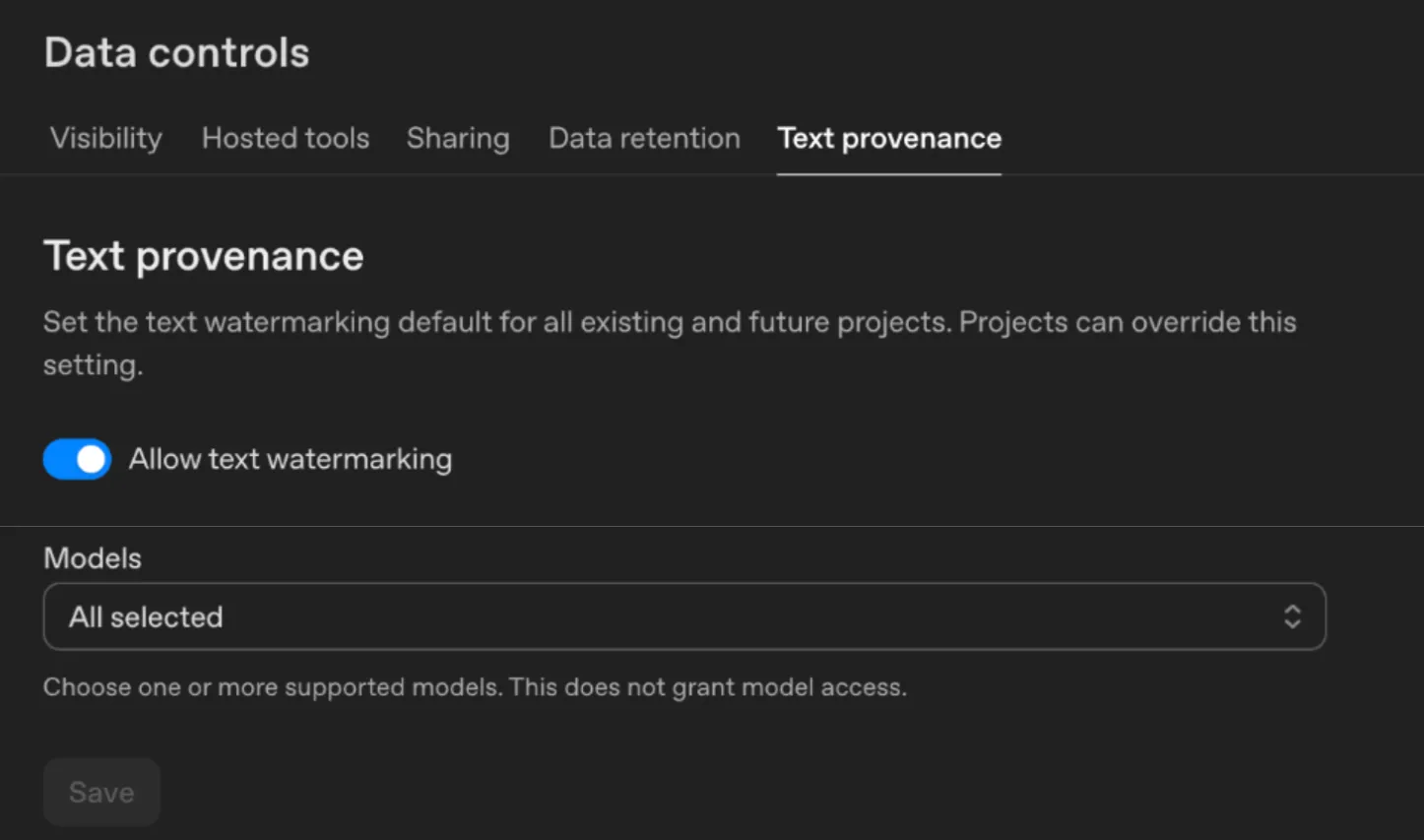
Illustration published by OpenAI in its Help Center, checked Oct. 7, 2026: the organization-wide default, which each project can override, shown switched on.
Writing tools built on the API. A service that calls an OpenAI model through the API produces watermarked text only if it has turned the option on for a supported model; OpenAI says the opt-in lets customers decide how watermarking fits their own transparency obligations. Koala offers OpenAI models (GPT-6 Luna and GPT-6 Sol) alongside Anthropic and Google models (Koala’s model page, checked Oct. 7, 2026) but has published nothing on watermarking, so its choice is undisclosed. Writesonic says neither which models power its AI Article Writer nor what it does about watermarking (homepage and pricing page checked Oct. 7, 2026).
Can a Teacher or Employer Detect ChatGPT Text?
Not with a public tool. As of Oct. 7, 2026, no teacher, employer or search engine has access to OpenAI’s text detector. OpenAI keeps it closed, citing the risk of missed watermarks and false positives, and reviews applications from researchers and expert organizations case by case.
For free-form text, the EU’s Code of Practice on Transparency of AI-generated Content, which OpenAI has signed, lets providers limit detection to verified expert users, such as regulators, media, fact-checkers, researchers and educational or research organizations, for a limited time (code published June 10, 2026; code and signatory list checked Oct. 7, 2026). Commercial AI detectors, which analyze writing patterns after the fact without OpenAI’s key, do not read this watermark, OpenAI notes.
Length and Subject Matter Make a Big Difference
OpenAI’s published results use a target false positive rate of 1%. As a calculation: out of 1,000 texts without a watermark, that target means about 10 false alarms.
| Passage length | Psychology questions | Math questions |
|---|---|---|
| 200 tokens | 78.5% | 36.5% |
| 300 tokens | 89.7% | 52.0% |
| 400 tokens | 94.3% | 60.8% |
Detection rates for watermarked answers to questions from the ELI5 dataset, at a 1% target false positive rate. Chart in OpenAI’s Oct. 5, 2026 announcement, checked Oct. 7, 2026. Publisher data, not a test by this site.
A token is a word or part of a word. Short or tightly constrained text is harder to detect: in math, the model has fewer ways to phrase an answer; the Help Center also flags code, highly factual answers and text the model copies back unchanged. The EU code of practice does not require watermarks on text shorter than 200 tokens, which OpenAI puts at about 150 words in English.
Editing Reduces Detection
| Passage length | Unedited | 10% of words replaced | 25% of words replaced |
|---|---|---|---|
| 200 tokens | 66.3% | 37.8% | 7.0% |
| 300 tokens | 84.8% | 56.3% | 11.6% |
| 400 tokens | 92.0% | 65.8% | 17.2% |
Detection rates at a 1% target false positive rate, from one pool of 600 watermarked English answers to ELI5 questions, with some words swapped for synonyms. Chart published by OpenAI on Oct. 5, 2026, checked Oct. 7, 2026. Publisher data, not a test by this site.
The two tables use different samples, which likely explains why unedited 200-token text scores 78.5% in one and 66.3% in the other. The Help Center adds that heavy paraphrasing or translation can make the watermark undetectable. The practical takeaway: a negative result proves very little.
Detection Varies by Language
Across all 24 official EU languages (500 prompts translated from English, 1% false positive rate), Spanish scored highest (69.0%) and Romanian lowest (42.2%, before the boost OpenAI gave languages below 60%). English needed no boost and sits at roughly 68%, a reading of the chart since OpenAI does not publish the exact figure (Help Center, checked Oct. 7, 2026).
What a Watermark Can’t Prove
OpenAI lists the limits of a detection result itself:
- Human contribution. A watermark can indicate that an OpenAI system generated or processed part of a passage, not how much human work went into it.
- Ownership and responsibility. It doesn’t say who owns the text, whether its use was lawful, whether disclosure was required, or who is responsible.
- The user. It doesn’t link the text to any person, organization, account, prompt or conversation.
- Accuracy. It doesn’t say whether a passage is true, misleading or shown in the right context.
- Human authorship. A missing watermark doesn’t prove a person wrote the text, which may be too short, edited or translated, come from an unsupported model, predate watermarking, or come from another company’s tools.
For a teacher, an editor or an employer, neither finding nor missing a watermark settles who wrote a piece.
Images, Video and Audio: openai.com/verify and SynthID Detector
For images and audio, public checks already exist; for text, they don’t. Supported images from ChatGPT, Codex or the API carry C2PA metadata and a SynthID watermark, audio a SynthID watermark, and openai.com/verify looks for those signals in an image or audio file (checked Oct. 7, 2026). On Oct. 7, 2026, Google opened SynthID Detector to everyone, worldwide: it checks whether an image, video or audio file was made with AI from Google or its partners, including OpenAI (Google’s announcement, checked Oct. 7, 2026). The tool describes itself as a watermark reader, not a general AI detector.
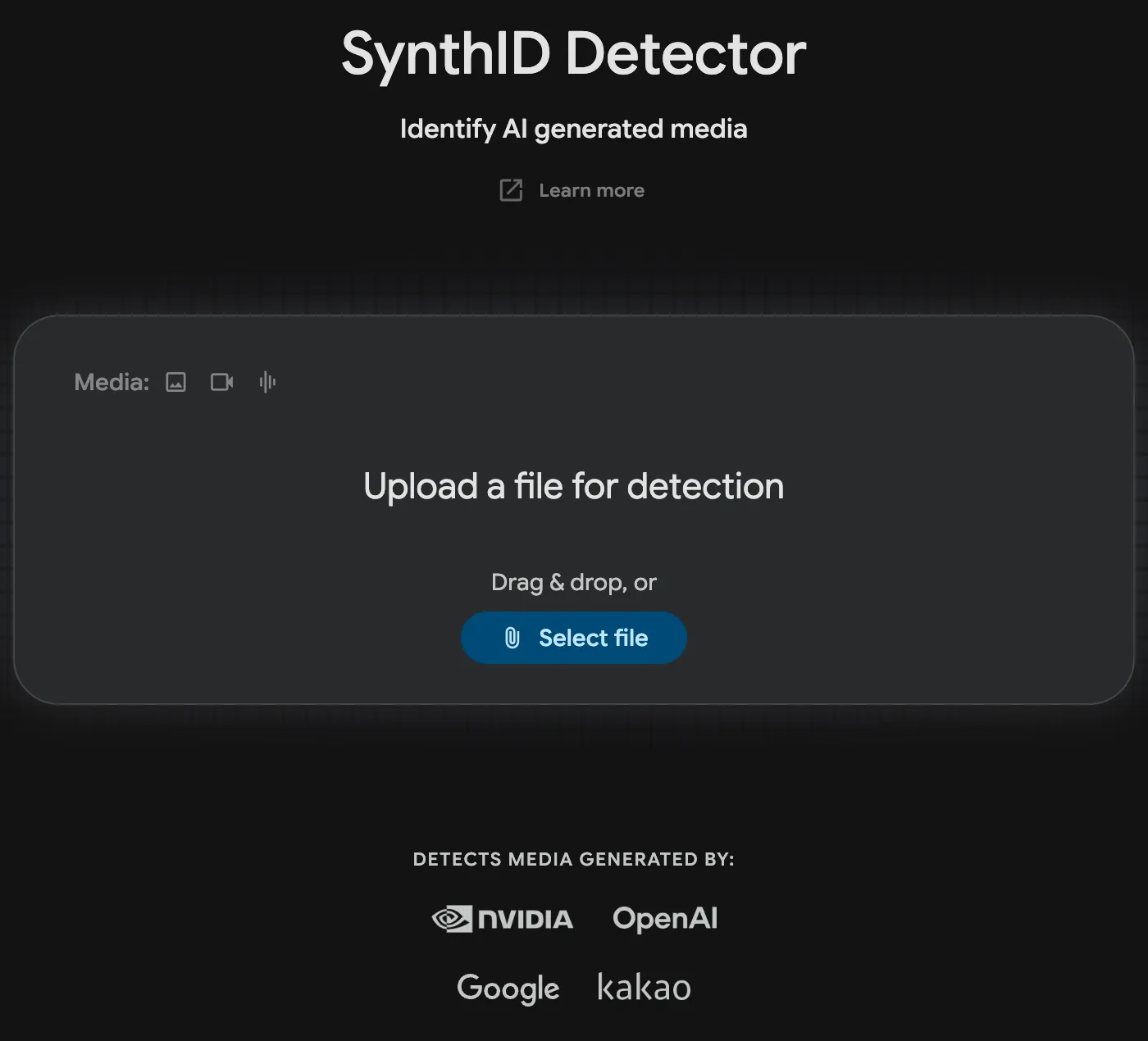
SynthID Detector’s public page, with the terms-of-service dialog hidden for the screenshot (Oct. 7, 2026): inputs for images, video and audio, none for text.
Why Only the EU? Article 50 of the AI Act
Article 50(2) of the EU AI Act requires providers of AI systems that generate audio, images, video or text to mark their output in a machine-readable, detectable way, unless the AI only assists with standard editing or doesn’t substantially alter the input. The transparency rules have applied since Aug. 2, 2026 (Article 113), but Article 111(4) gives generative AI systems already on the market before that date until Dec. 2, 2026 to comply with the marking rule (dates checked Oct. 7, 2026 in the consolidated text on EUR-Lex and on the Commission’s fact page). On a plain reading, that is ChatGPT’s deadline; OpenAI does not tie its timeline to it.
OpenAI is not making text watermarking a global default: it says the EU-only approach gives it room to learn from real-world use before going further. Anthropic made a different call: text from its future Claude models will carry a watermark worldwide at launch, because it has no durable way yet to limit it to one region (Anthropic’s explainer, Aug. 14, 2026, updated Sept. 1, 2026, checked Oct. 7, 2026).
What about US law? California’s AI Transparency Act, operative since Aug. 2, 2026, requires providers of generative AI systems publicly accessible in California to embed latent disclosures, where technically feasible, in AI-generated images, video and audio, and to offer a free verification tool; text is not covered. SB 1000, in effect since Sept. 30, 2026, removed the earlier threshold of over 1 million monthly visitors or users (Business and Professions Code §22757.2 and §22757.3, as amended by SB 1000, and §22757.6 for the start date, checked Oct. 7, 2026). Federal and state rules: see our AI regulation guide.
What Should Writers, Students and Businesses Do?
Watermarking is a duty of AI providers: it doesn’t replace visible labels that publishers may need, as OpenAI’s Help Center states plainly.
| Your situation | What the watermark changes | What to check |
|---|---|---|
| Student using ChatGPT in the US | Nothing at launch; no public tool reads the watermark | Your school’s AI policy and any disclosure it requires |
| Writer or publisher with EU readers | ChatGPT text from eligible EU users will be watermarked once the rollout happens | EU rule: label AI-generated text on matters of public interest unless a human reviewed it and someone takes editorial responsibility (Article 50(4)) |
| Business using the API or a writing tool | Nothing by default in OpenAI’s API; for a third-party tool, it depends on the vendor | Whether to turn it on, and your own obligations as a provider or deployer, with counsel |
Spell-checking or grammar fixes alone don’t count as review, according to the Commission’s Article 50 FAQ (updated July 24, 2026, checked Oct. 7, 2026). To keep control of AI-assisted drafts, see our guide to writing high-quality content with ChatGPT. The EU also offers optional icons for labeling AI-generated content.
These pointers describe official texts as of Oct. 7, 2026. This is not legal advice: for a specific case, talk to a lawyer or the EU’s AI Act Service Desk.
FAQ
Is my ChatGPT text already watermarked?
Not in the US, which the rollout doesn’t cover. In the EU, no public tool can check as of Oct. 7, 2026: OpenAI’s announcement says “over the coming weeks,” with no date, yet its English Help Center article, updated Oct. 6, 2026, already says in the present tense that ChatGPT text in the EU carries the signal.
Can teachers detect ChatGPT text with this watermark?
Not today. OpenAI’s text detector is open only to approved researchers and expert organizations, by application. Even with access, a result doesn’t show who wrote the text or how much of it is human work.
Does the watermark change the wording or add hidden characters?
OpenAI says it adds no characters, spaces or visible marks: it steers the choice between plausible words. OpenAI also says it sees no drop in quality; that is its own evaluation.
Will text from Koala or Writesonic be watermarked?
Not with OpenAI’s watermark unless the vendor chooses to: text generated with an OpenAI model through the API is watermarked only if the service turns the option on. Koala also offers models from other companies, which follow their own rules. As of Oct. 7, 2026, neither Koala nor Writesonic had said anything about watermarking.
Can SynthID Detector check text?
No. Google’s tool, opened to everyone on Oct. 7, 2026, checks images, video and audio. openai.com/verify is also limited to images and audio.
Can the watermark identify me?
No, according to OpenAI: it doesn’t link the text to any person, account, prompt or conversation. It only indicates that an OpenAI model likely generated or processed the passage.