Gemini 4 Argon: What Google Announced and Who Gets Access
Google announces Gemini 4 Argon with restricted initial access. Explore the announced API prices, a worked cost example and what its benchmarks actually show.
Contents
Google announced Gemini 4 Argon on September 30, 2026. As of October 1, initial access is restricted to selected cybersecurity partners; the public rollout is still ahead. Having a Gemini subscription does not guarantee access today. Here is what the announcement means for users and API budgets. Sources: Google’s announcement and the Fairwind Program, checked October 1, 2026.
Who Can Use Gemini 4 Argon?
| Audience | Status as of October 1, 2026 |
|---|---|
| Selected Fairwind partners | Controlled initial access for cybersecurity defense |
| Paid API customers and Google AI Ultra subscribers | First announced stage of wider access; no firm date |
| Other users | No confirmed rollout schedule in the announcement |
Fairwind prioritizes organizations such as government agencies and critical infrastructure operators. Applications are reviewed; signing up does not guarantee activation. Partners are also prohibited from reselling or redistributing access. Google DeepMind explains the program’s eligibility and access rules.
The practical takeaway: do not buy a plan solely for Argon until availability is confirmed for your account. Our Google Gemini guide covers the existing product and subscription options. This article covers the model announcement, rather than a new Gemini subscription tier.
What Changes: Longer Tasks and Outputs
Google positions Argon for coding, professional research and tasks spanning multiple steps. The announcement raises the output limit to one million tokens, from 64,000. Output is what a model can generate; it is distinct from the documents you supply as input. Source: Google’s model announcement.
For a development team, the useful question is whether a model can finish a verifiable task: change several files, preserve expected behavior and deliver a usable fix. A longer answer alone does not establish that. It can also increase review time, spending and the amount of material that needs checking.
Google describes vulnerability discovery and automated patching among the cybersecurity model’s capabilities. Those are controlled defensive uses. They do not establish that software becomes vulnerability-free after an automated fix.
The Benchmarks Show Trade-Offs
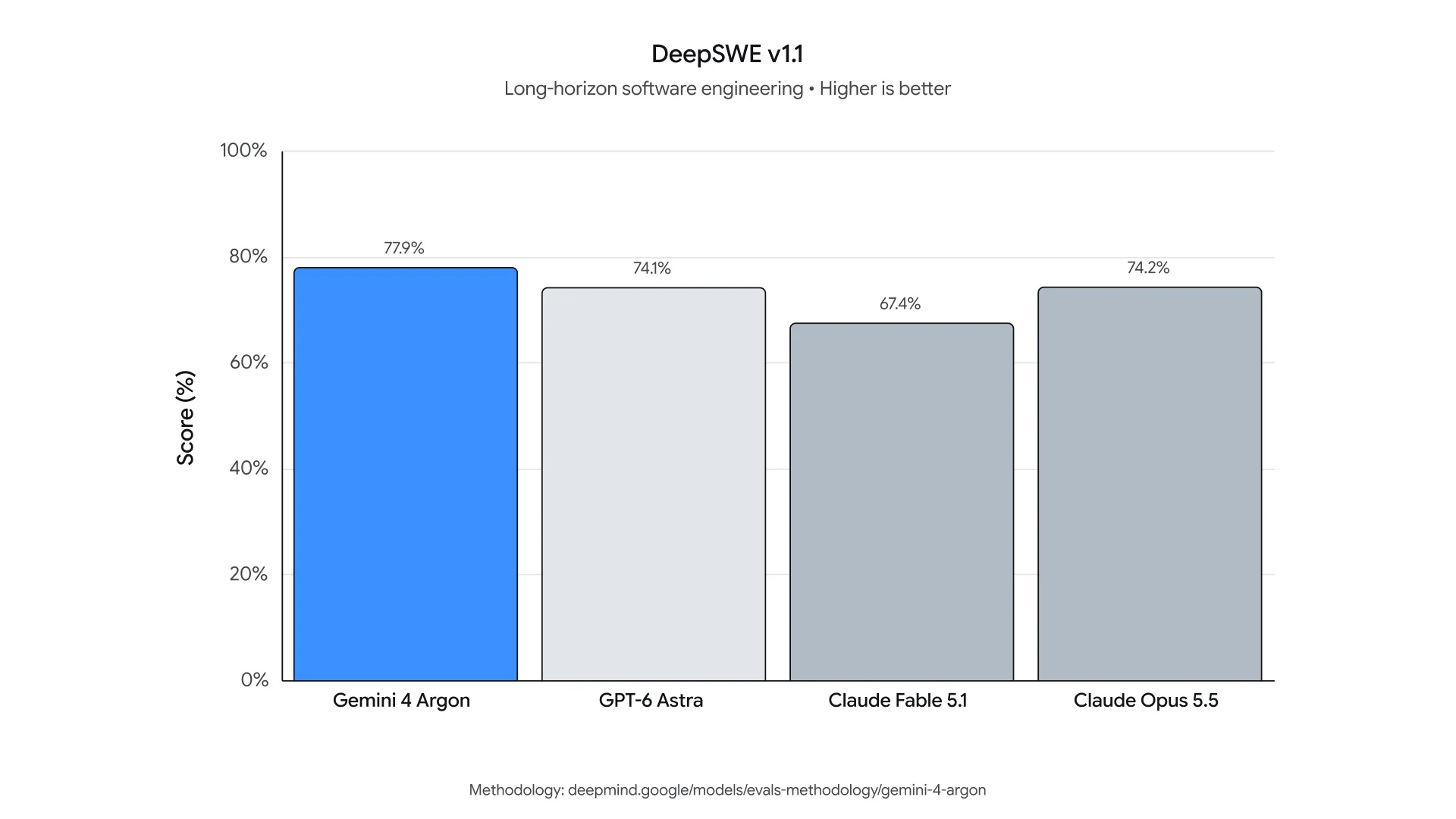
Chart published in Google’s Argon announcement, checked October 1, 2026. It illustrates the reported lead on DeepSWE v1.1, an evaluation of long-horizon software engineering tasks. The other evaluations below show why this ranking should not be generalized. View the full-size chart.
The results published by Google DeepMind include a useful contrast:
| Evaluation | Gemini 4 Argon | GPT-6 Astra | Claude Opus 5.5 |
|---|---|---|---|
| DeepSWE v1.1 | 77.9% | 74.1% | 74.2% |
| FrontierSWE v2 | 55.0% | 65.5% | 62.3% |
| Terminal-bench 4.0 | 57.4% | 58.2% | 66.4% |
Selected results reported by Google, checked October 1, 2026. The evaluations use different protocols; their percentages should not be added together.
Argon leads these two competing models on the first row and trails them on the next two. That is not evidence that one model replaces every other coding tool. A coding benchmark also says little about whether an assistant writes a useful customer email or fits your team’s approval process.
Before purchasing, prepare representative tasks: a reproducible bug, a report that needs traceable sources, or a change with automated acceptance tests. Record the final quality, retries and total cost. Compare completed work under the same requirements, rather than answer length or a single leaderboard position.
Announced Pricing: A Worked API Budget
Google’s announcement lists introductory rates of $2 per million input tokens and $10 per million output tokens, followed by $4 and $20. It does not specify when introductory pricing ends. The Gemini API pricing page, checked October 1, 2026, does not yet list Argon.
Calculated example: assume a job bills 100,000 uncached input tokens and 20,000 total output tokens. These are hypothetical billable volumes, not a promise about what a particular document requires.
| Calculation | Announced introductory rate | Announced subsequent rate |
|---|---|---|
| Input: 0.1 million tokens | $0.20 | $0.40 |
| Output: 0.02 million tokens | $0.20 | $0.40 |
| Total for one job | $0.40 | $0.80 |
| 100 identical jobs | $40 | $80 |
This hypothetical budget excludes taxes, additional tools, storage and retries. Check the actual billing details when access launches, including how reasoning is counted. If retries double the billable volume, they double this budget too. A per-token price is not a fixed fee per finished report or successful task.
What Should You Prepare Before Access Opens?
Keep your existing setup until you can measure an improvement. Prepare a task set, spending cap and acceptance criteria for a future comparison. For example: “fix this bug, pass the tests and explain the changed files” is a clearer target than “write a lot of code.”
If your goal is a business application without managing a development stack, our no-code and AI app builder guide compares complete products. A model announcement and a ready-to-use service solve different purchasing questions.
FAQ
Is Gemini 4 Argon Available for Free?
The announcement does not confirm public free access. It describes a phased rollout starting with selected partners.
Should You Upgrade to Google AI Ultra Now?
Not solely on the promise of Argon. Wait for confirmed availability and account-specific limits before changing plans for this model.
Which Rate Should You Use for an API Budget?
Use the announced post-introductory rate for planning, then allow for retries. In the example above, that starts at $80 for 100 jobs, before additional charges.