Eleven v4 Arrives: What Changes for Voiceovers and Agents
Eleven v4 and v4 Turbo are available. See what changes from v3, voice cloning limits and the cost of 100,000 characters, separate from creator plans.
Contents
ElevenLabs launched Eleven v4 and v4 Turbo on September 28, 2026. The first targets narration and prepared dialogue; Turbo targets live voice interactions. Both are available through ElevenCreative, ElevenAgents and the API, according to the official announcement, checked October 1, 2026. For creators, the practical question is whether the new delivery fits their work—and whether an existing voice still sounds familiar.
This report covers the launch and conditions observed on October 1, 2026. The ElevenLabs guide covers subscriptions and the rest of the platform.
What Does Eleven v4 Change From v3?
Two documented changes are easy to compare: the v4 family supports over 90 languages, versus over 70 for v3, and v4 accepts up to 10,000 characters per request, versus 5,000 for v3 (model documentation, checked October 1, 2026).
For a training script, the larger allowance can avoid splitting an explanation halfway through. Working in scenes still makes editorial sense: fixing one sentence should not require rebuilding an entire chapter.
Bracketed delivery instructions remain available. Tags such as [whispers] and [laughs] work with both v3 and v4, so moving to the new model does not require discarding every existing direction (audio tag help, checked October 1, 2026).
Existing voices deserve a careful listen. ElevenLabs says a clone can sound noticeably different under v4. When generating in a different language from the reference recording, the model also aims for a natural target-language accent instead of automatically retaining the source accent (v4 guide, checked October 1, 2026).
That distinction matters for a recognizable brand voice. Smoother localization may suit a product explainer; a fictional character whose accent is part of the performance needs a different editorial decision.
Listen before choosing: the launch announcement includes official audio samples, including an original recording followed by its cloned version. Compare timbre, breaths and sentence endings. These are examples selected by ElevenLabs, not a guarantee of the result on your own recording.
v4 or v4 Turbo: Which Job Fits Each Model?
| Your project | Version to evaluate | What should decide it |
|---|---|---|
| Voiceover, audiobook or prepared dialogue | Eleven v4 | The finished passage after listening and corrections |
| Voice assistant or interactive character | Eleven v4 Turbo | Response time in the complete application |
These roles follow the model documentation, checked October 1, 2026. Turbo’s lower price is not enough to make it the default for every production.
ElevenLabs reports roughly 100 ms median inference latency for Turbo and around 150 ms to first speech under its benchmark protocol, excluding network latency (launch announcement, checked October 1, 2026). This is not the full response time of an assistant: recognizing the request, preparing an answer and delivering it over the network remain part of the experience.
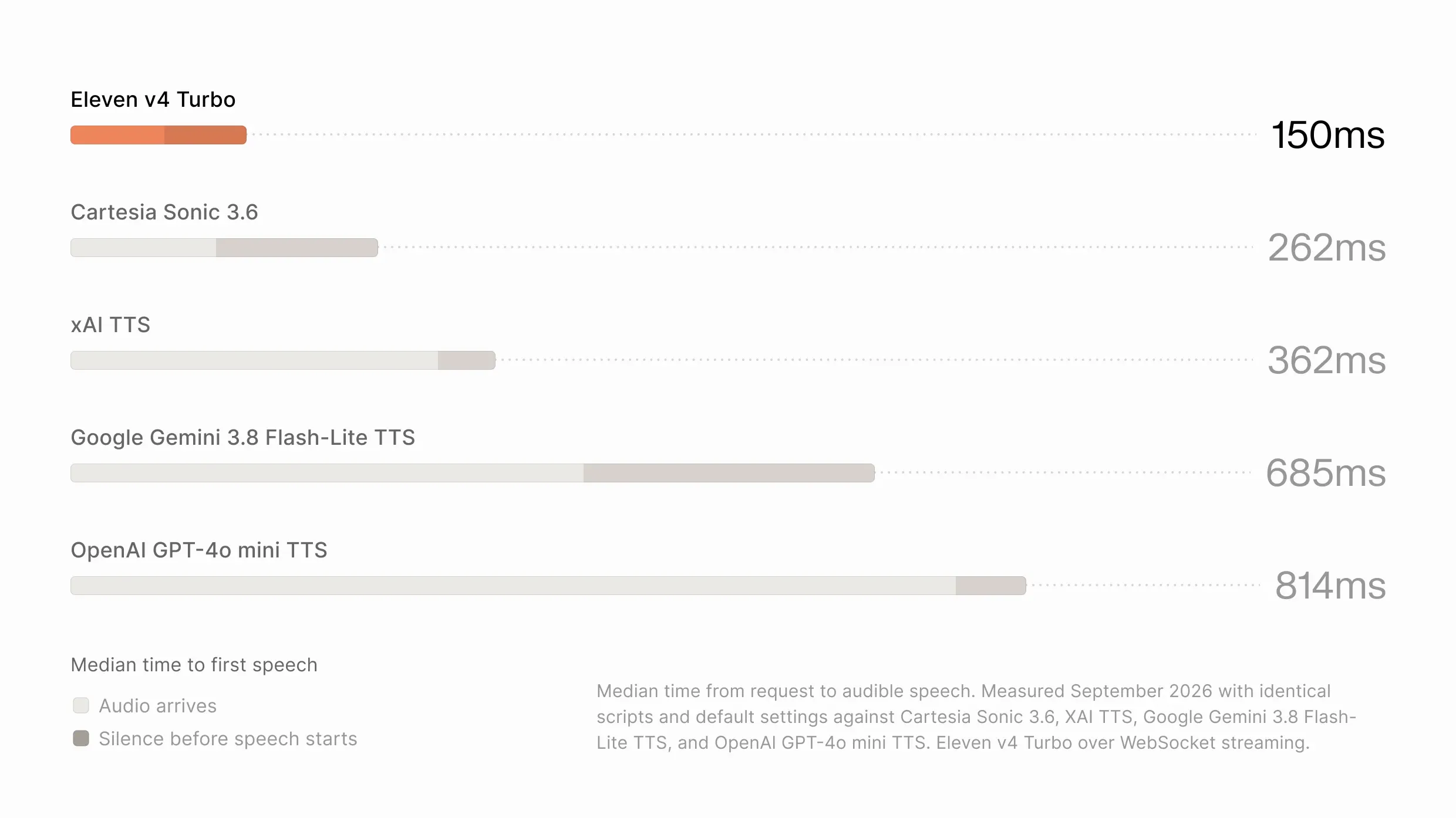
Measurements published in ElevenLabs’ announcement, checked October 1, 2026: identical scripts, default settings, network latency removed; v4 Turbo uses WebSocket streaming. These are vendor results, not an independent test or the full response time of an assistant. View the full-size chart.
There is also an API distinction: the Text to Dialogue WebSocket accepts up to ten registered voices per connection with v4, but only one with Turbo. That restriction applies to this streaming interface, not to the size of your voice library (WebSocket comparison, checked October 1, 2026).
What Do 100,000 Characters Cost Through the API?
The following is a calculation for a total of 100,000 characters generated once, split into suitable requests. Prices are in U.S. dollars before tax, from the API pricing page, checked October 1, 2026.
| Model | Reference rate per 1,000 characters | Temporary rate advertised through October 12, 2026 | Calculated total for 100,000 characters: reference / promotion |
|---|---|---|---|
| v4 | $0.08 | $0.022 | $8 / $2.20 |
| v4 Turbo | $0.04 | $0.011 | $4 / $1.10 |
Calculation: 100,000 ÷ 1,000 × rate. Corrections that generate more audio increase the character total. For a budget extending beyond the launch offer, use the reference column rather than treating the discount as permanent.
These figures do not price a creator subscription or a complete voice agent. They isolate text synthesis through the API. A production budget also needs an allowance for revisions and any other services involved.
How Can Creators Access It?
In the app, Free includes 10,000 monthly credits. Starter is $6 per month before tax and adds a commercial license and instant voice cloning (Creative pricing, checked October 1, 2026). Those allowances are separate from the API rates above.
The ElevenLabs voice creation tutorial explains how to prepare a script and choose a voice in the interface.
Try ElevenLabs — affiliate link: Génie Artificiel may earn a commission if you subscribe, at no additional cost to you.
Should You Regenerate Existing Voiceovers?
A higher version number is not a sufficient reason. Choose a representative passage: a neutral sentence, a change in emotion, a proper name and a longer sentence. Compare pronunciation, tone and continuity with the videos already published. A dramatic sample may be impressive while consistency across a training series matters more.
Changing the model does not automatically improve existing files. In Audiobooks, affected passages must be regenerated to use the new model, which consumes credits (Audiobooks guide, checked October 1, 2026).
Finally, Eleven v4, Studio 4.0 and Dubbing v2 are different products. Studio 4.0 is the editing environment announced on September 21; Dubbing v2 handles audio and video translation and remains labeled alpha, without an in-app editor, as of October 1 (Studio announcement, Dubbing documentation). For an existing video, the guide to translating video while keeping your voice covers that workflow. Choosing a v4 voice does not replace it.
FAQ
Does Eleven v4 Support French?
Yes. French is listed among the v4 family’s supported languages. For a brand voice, evaluate the accent and pronunciation on your own script as well as checking language availability (models, checked October 1, 2026).
Does v4 Keep All the Previous Voice Settings?
No. The v4 guide lists Stability and Similarity, but no Style or Speed sliders and no SSML support. Existing scripts that rely on SSML pauses need adjustment (v4 guide, checked October 1, 2026).
Does the API Discount Also Apply to App Credits?
They are separate offers. As of October 1, 2026, Creative advertises an offer through October 12, 2026: v4 generations that do not reduce the balance, capped at twice the monthly TTS allowance on Creator and higher plans, on web and mobile only. This is neither an API rate nor a permanent tripling of every credit allowance (displayed terms).